Subscribe to Computing Intelligence

Showing posts with label Miscellaneous. Show all posts
Showing posts with label Miscellaneous. Show all posts
Wednesday, June 2, 2010
Sir Patrick Day
March 17th might be St. Patrick's Day, but now June can join the club with Sir Patrick day. Everyone should sit back with a nice cup of tea, Earl Grey, hot, and boldly go where no one has gone before (or at least watch these videos).


Tuesday, March 2, 2010
Beyond The Streisand Effect
The Streisand Effect is a term bandied about on the internet to describe situations when attempted censorship backfires and ends up amplifying interest in the targeted information or event rather than suppressing it. In what is possibly one of the most dramatic cases of litigious bullying backfiring, the British Chiropractic Association (BCA) sued Simon Singh for libel after he called some of their unsubstantiated claims (such as chiropractic treatment for asthma and colic) 'bogus', and now find themselves in the ignominious and entirely fitting position of having one in four chiropractors under investigation for misleading medical claims (including some of the BCA's own officers). I am greatly impressed with Simon Singh's tenacity and backbone, and I think he and his supporters deserve a great deal of credit for taking a stand for critical journalism.
Friday, February 12, 2010
Busy Day
Today is the 201st anniversary of Darwin's birthday, the Winter Olympics are starting, and I've got a whole mess of brains to co-register into a common space (a task which is proving far more difficult than it ought to be, considering how often published neuroimaging results are based on co-registered brains). I had planned to offer some commentary on the Olympics, but I wasn't able to find some of the links I wanted and now I don't think I will have the time to properly formulate my thoughts (perhaps that will come in a few days). I will, however, offer a brief tidbit of information that recently came to my attention concerning the city of Darwin, Australia.
Darwin is a lovely city, albeit suffering from an overabundance of humidity and, occasionally, the dreadful propensity common to many coastal tropical cities for inclement weather. When I visited Darwin as a child, however, I never even questioned how Darwin got its name. As I believe I have mentioned before, I was wildly into dinosaurs as a child and as such had quite a bit of exposure to de-facto acceptance of evolutionary theory. I was vaguely aware of some controversy when the idea was first introduced, but the fact that evolution was obstinately resisted by people living in the modern world had never even crossed my mind. Darwin, therefore, was a name I recognized for eminent scientific achievement and world-wide influence, and thus as fitting a name as any for a city. Apparently, however, Darwin was not actually named after Charles Darwin for his scientific achievements, but rather received its name because one of Darwin's former ship-mates was simply going down a list of old sailing buddies and naming places after each in turn. I guess it is just convenient that one of the most important cities in the Australian north ended up catching the most notable name on the list.
Darwin is a lovely city, albeit suffering from an overabundance of humidity and, occasionally, the dreadful propensity common to many coastal tropical cities for inclement weather. When I visited Darwin as a child, however, I never even questioned how Darwin got its name. As I believe I have mentioned before, I was wildly into dinosaurs as a child and as such had quite a bit of exposure to de-facto acceptance of evolutionary theory. I was vaguely aware of some controversy when the idea was first introduced, but the fact that evolution was obstinately resisted by people living in the modern world had never even crossed my mind. Darwin, therefore, was a name I recognized for eminent scientific achievement and world-wide influence, and thus as fitting a name as any for a city. Apparently, however, Darwin was not actually named after Charles Darwin for his scientific achievements, but rather received its name because one of Darwin's former ship-mates was simply going down a list of old sailing buddies and naming places after each in turn. I guess it is just convenient that one of the most important cities in the Australian north ended up catching the most notable name on the list.
Wednesday, February 10, 2010
Risk Intelligence
I meant to post a link to this last week after PZ Myers mentioned it, but then I wanted to try taking the test first which meant my post got delayed and then forgotten about for a few days. If you haven't already had a look at the Risk Intelligence test, though, I think it is worth going to (as far as internet intelligence tests go). The basic idea of the test is that you don't simply answer every statement with a True/False response, but rather with a percentage - 50% meaning you have no idea and think the statement as equally likely to be true or false, 100% meaning you are certain it is true, and 0% meaning you are certain it is false. There are 10% increments in between for all of those pesky facts that you are pretty sure you've heard somewhere else, but you wouldn't bet anything much of value on.
I scored a 78 - apparently that is a rather good score, but not as good as PZ Myer's 83. It would seem that I lack confidence in my responses (judging by the response curve given at the end). Of course, I don't know how much stock to place in any internet quiz, but I still thought it was an interesting project. Plus, whoever put it on seems to be gathering data, so you might be helping out someone's research by taking the test.
I scored a 78 - apparently that is a rather good score, but not as good as PZ Myer's 83. It would seem that I lack confidence in my responses (judging by the response curve given at the end). Of course, I don't know how much stock to place in any internet quiz, but I still thought it was an interesting project. Plus, whoever put it on seems to be gathering data, so you might be helping out someone's research by taking the test.
Thursday, October 1, 2009
Fascinating Art
I have only recently been made aware of the artist Liu Bolin, a modern Chinese artist who paints himself into pictures. This is apparently done without photo editing tricks, and is quite impressive. I wonder what would some of these shots would look like when physically at the scene, and I am also quite curious what he uses to paint himself.

You can read an article about Liu Bolin, and then view this more extensive gallery of his work.

You can read an article about Liu Bolin, and then view this more extensive gallery of his work.
Monday, July 6, 2009
Talk Stress
Tomorrow at 10:00 I have to give a talk on what I have done since I got here. A month is not a great deal of time to have actually achieved anything, so the talk is mostly an overview of the mathematics behind the analysis of oscillatory networks that we are doing. Since I have had to learn a lot of the math in the past few weeks, I'm not feeling particularly confident in my full ability to do the topic justice (especially since the Ph.D. student who I am working under and who has spent several years developing an intuitive grasp of the subject is also going to be in the audience, likely cringing at every other sentence as I subtly butcher the actual explanations). The presentation still has a fair bit of work to go, but I thought some pictures of small furry critters might help set my mind at ease. In case any of my readers happen to be stressed as well, I thought I would share the pictures with you.
 A baby and adult capybara - the largest extant rodent species.
 A pika - a small lagomorph (not a rodent) native mostly to mountains in North America, Asia, and Eastern Europe.
 A cheetah cub. Cheetahs are unfortunately suffering from a dangerous lack of genetic diversity due to a population bottleneck from about ten thousand years ago. This means their population is drastically inbred, resulting in low fertility levels and other health problems that threaten their survival.
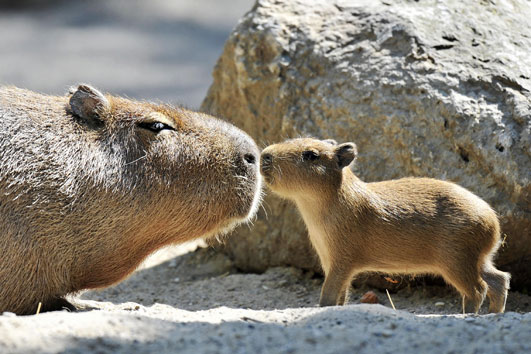 A baby and adult capybara - the largest extant rodent species.
 A pika - a small lagomorph (not a rodent) native mostly to mountains in North America, Asia, and Eastern Europe.
 A cheetah cub. Cheetahs are unfortunately suffering from a dangerous lack of genetic diversity due to a population bottleneck from about ten thousand years ago. This means their population is drastically inbred, resulting in low fertility levels and other health problems that threaten their survival.
So, there you have it. Three adorable pictures with a little bit of trivia to go along with them. Now it's time to go back to preparing my presentation...
Sunday, July 5, 2009
"Tea, Earl Grey, Hot."
 One of the things that has always fascinated me is the idea of acquired tastes. As a child, whenever someone told me a food was an acquired taste, I wondered just how people ever got started eating it in the first place. For example, I found tea and coffee to be absolutely vile drinks (coffee more so than tea... in fact, I still dislike coffee greatly. Although some predicted that I would never make it through my undergraduate education without learning to drink coffee, it would seem I have proven them wrong). They are also fairly non-trivial to prepare, so one would wonder how and why someone would go through all the effort of preparing coffee grounds or crushed tea leaves, boiling water, and steeping a drink that, on first taste, prompted a scrunched face of disgust. Of course, not everyone seems to have my initial dislike for the drinks, so perhaps the few people who enjoy such bitter draughts convinced everyone else to give it a try.
Alcoholic drinks are another confusing item, as they too are quite non-trivial to prepare. While one might suppose that there was an ancient group of people with a particularly good crop of grapes one year. They juiced some of the excess fruits and stored them in casks, but were not able to consume the juice fast enough to prevent it from starting to go off. A few might have braved the possible stomach ache and consumed the spoiled juice, only to discover a pleasant buzzing which prompted further experimentation in reproduction. Of course, this sort of story might sound plausible, but it is the sort of "just-so" story which plagues fields like evolutionary psychology. With only the vaguest of evidence to support it (namely, wine exists now, so it was discovered at some point), the story could just as easily have been some ancient teenager stole his neighbour's jar of juice, buried it in a field for a few weeks, and then forced his little brother to drink it just to see what would happen.
The reason I have been ruminating on the subject of acquired tastes, though, is I always find it fascinating when traveling to discover the regional acquired tastes, both of the place one has traveled to and of one's home region. For example, vegemite is a vile spread for toast and bread in Australia. Australians, howe
 ver, do not seem to share my abhorrence for its flavour (judging by the fact that it is still manufactured, sold, and consumed there). While I have yet to discover any popular German cuisines that turn my stomach, I have been informed by several of my European peers who have spent a fair bit of time studying in North America that root beer is a horrible drink, and they don't understand how North Americans can drink the stuff. Oddly, peanut butter is also one of those things which is often raised as a peculiar North American food, although the reactions to it tend to be more divided with some deciding it is unpleasant and others wishing it was more common here.
So, there was not a lot of point to this post. I do not have any answers for why certain flavours are popular in certain regions of the world, nor how people ever got to manufacturing and consuming some of our stranger and more acquired tastes. Idle conjecture can be fun, though.
Monday, January 5, 2009
A Minor Dose of SIWOTI Syndrome
I thought it was slightly ironic that I would have a case of SIWOTI Syndrome with xkcd itself, which is why I thought I'd set the record straight. While I appreciate the sentiment of the Converting to Metric comic, I think it should be pointed out that -10 degrees Celsius is not a cold day in Moscow. Having lived there for two years, I think it should be pointed out that days don't start being regarded as cold until you go below -20 or -25, and actually cold days are in the -30s. My school had a rule that it would be cancelled if the temperature ever hit -40, but, sadly for me, the coldest winter day I experienced in my two years there was -39.5.
Funnily enough, I have a story about -10 and Moscow. When my Argentinian brother-in-law was visiting my family in Moscow, he found it awfully cold (he would agree with xkcd that -10 was a cold day, despite what the Russians and Canadians might say). One day he was out with my sister and my parents (it was -10 degrees C at the time) and he spotted a band of Russian fellows in the park practicing soccer. He was quite horrified, explaining that he would not practice if it were 10 degrees outside since that would be too cold. So, I suppose what is cold is a little relative, but if one is going to tabulate a chart of reference points, the "Cold Day (Moscow)" entry should be adjusted to a slightly more accurate value.
Funnily enough, I have a story about -10 and Moscow. When my Argentinian brother-in-law was visiting my family in Moscow, he found it awfully cold (he would agree with xkcd that -10 was a cold day, despite what the Russians and Canadians might say). One day he was out with my sister and my parents (it was -10 degrees C at the time) and he spotted a band of Russian fellows in the park practicing soccer. He was quite horrified, explaining that he would not practice if it were 10 degrees outside since that would be too cold. So, I suppose what is cold is a little relative, but if one is going to tabulate a chart of reference points, the "Cold Day (Moscow)" entry should be adjusted to a slightly more accurate value.
Tuesday, November 25, 2008
Some Random Cuteness
This video I found adorable, and it makes me miss having pets around. Last night I went to a friend's house where there are two cats, and, though I rationally recognize why living in a small place on a student budget makes having a pet unreasonable, I really wanted a cat of my own. This is especially true since Sparky, my family's calico cat and sole remaining pet from my childhood, passed away a few months ago, so now I don't even have a cat to return to visit on holidays. Anyway, this was meant to be a light-hearted and humorous post (it's a cat going down stairs in an awkward fashion!), so to try and lighten the mood again I will reference another of my favourite xkcd comics.
Thursday, October 30, 2008
Funny Names and TAing Fears
While working on a rather pointless report last night, I discovered that one of the original designers of the laboratory has one of the most amazing names I have ever heard: Dr. Cosimo Commisso. I considered doing a Scientific Appreciation post about him, but decided that was a little unfair since I was only drawn to him as a scientist due to his enjoyable name (that and I couldn't actually find any information about him when doing a quick Google search... Wikipedia only has an article on a Canadian soccer player who is also apparently named Cosimo Commisso and some sort of Italian organized crime fellow). Anyway, while perhaps an inane thought, I really liked his name... it kind of reminded me of some sort of Mensa or IQ test question:
Cosimo Commisso ...
What is the next word in the above pattern?
A.) Commmissso
B.) Coio
C.) Cosssimmmo
D.) Coosimoo
The answer is, of course, C for Cosimo Commisso.
Speaking of funny names, though, many of my friends are TAing courses this year. One such TA had the unenjoyable task of marking a giant stack of papers the other day, but one of the enjoyable outcomes of that task was he discovered on the students in his class had the last name, "McFail". I feel quite badly for that student, because that is a remarkably unfortunate last name, especially since the poor kid apparently did fail one of the tests (although the student did pass the second test with enough of a margin to pass over all, prompting my friend to consider writing "Congratulations, you McPassed!" on the paper, but his better judgement overruled him). It makes me worry, slightly, for when I am a TA and have to do large stacks of marking. Hours of tedious work tend to errode my judgement, as was the case in first year when I made up highly imaginitive names for my computer program variables (before finally getting docked a significant number of 'style' points to bring that practice up short). I just don't want to end up a bitter TA who leaves comments on papers like those I received in one of my third year courses, including (if my memory serves me correctly), "Don't know basic algebra??", "You're very wrong here", and a smiley face next to some lost marks (that one was the most confusing).
Monday, October 13, 2008
Happy Thanksgiving
It is Thanksgiving weekend in Canada, so I thought I would do a little research (on Wikipedia, of course) into Thanksgiving. While I encourage everyone to go read about it themselves, if you just want some fun trivia highlights, here they are:
As is fairly common knowledge, Canada celebrates Thanksgiving on the second Monday of October, while in the United States it is celebrated on the fourth Thursday of November.
While the first Thanksgiving celebration is popularly regarded as being put on by the pilgrims at Plymouth, the first recorded Thanksgiving celebration in America actually took place in Florida in 1565, put on by the Spanish.
Thanksgiving is a statutory holiday everywhere in Canada except New Brunswick, Newfoundland, and Prince Edward Island.
The timing of Thanksgiving in Canada was not fixed to October until 1957. Prior to World War I (starting in 1879), it moved around from year to year and was themed based on something that everyone should be thankful for. After World War I it was observed in whatever week contained November 11 (Armistice Day, later renamed Remembrance Day).
Grenada also celebrates a Thanksgiving Day, but for a completely different reason. Thanksgiving in Grenada is celebrated on October 25th and marks the invasion of the island by a US-led force in 1983 in response to a military coup.
If you are waiting until Monday evening to celebrate your Thanksgiving (or if you are American and won't celebrate until November), now you have some trivia to evoke awe and adulation from your relatives with between bites of turkey and mashed potatoes.
Monday, August 25, 2008
A dearth of posts
Just thought I'd make a note of why there have been so few posts lately... I am visiting my parents. That means sometimes spotty internet connection, lots of alcohol (although never an inordinate amount at once), an endless supply of cherries, wrestling, and game playing. What that ultimately ends up meaning is I don't spend a lot of time on the computer, and hence I don't do much on my blog. Just in case readers were getting worried... I will be back in Toronto later this week.
Saturday, August 16, 2008
A short note while enroute: Movies!
I am currently in the Calgary airport killing time before my last flight (this one is just a short hop over the mountains to get me almost home... just an hour and a half drive after that. Oh, the joys of coming from a puny little mountain town without a commercial airport). I almost watched two movies on my flight from Toronto, but unfortunately the second one got cut off with only twenty minutes left. Anyway, I finished Vantage Point, which I have to say was a remarkably disappointing movie. It had a few minutes in the middle that were good, but by the end I had a distinctly disappointed feeling.
The second movie I started watching was The Bank Job. It was enjoyable in that it wasn't a typical heist movie (like I originally thought it was going to be) where the whole plot revolved around the job itself, but instead was a much more interesting fictional-historical movie where the main plot had to do with the ramifications of the crime in relation to the multitude of conflicting motives belonging to the different conniving parties. Also, I enjoy Jason Statham as an actor. I'm not particularly sure why, since he has been in some pretty bad movies as well as some good ones, but he has an enjoyable English charm.
Anyway, I'm going to watch some news about the Olympics now, and then go and catch my plane.
Monday, June 30, 2008
SIWOTI Syndrome...
I had this article shared with me a while ago, and it bugged me enough that I thought it deserved a rebuttal. After all, how could I abide by someone being wrong on the internet?
I think it is important to start off with a brief discussion of what graduate school is. To make sure I wasn't confused about my definition, I looked it up on Wikipedia to get the popularly held concept of graduate school. As I suspected, graduate school primarily refers to degrees earned following a bachelors, and medical school, law school, and an MBA are all referred to as graduate school either unusually or rarely. One way Penelope Trunk may perhaps have realised this, other than looking it up, might have been to think about the names of the standardized tests involved in getting into these different programs. Graduate school tends to require the GRE (Graduate Record Exam), whereas med school requires the MCAT, law school the LSAT, and business school the GMAT.
1.) Her confusion of what graduate school actual consists of is first flagged here. While an argument may be made for the opportunity cost of graduate school (you are not working, and thus are missing out on two to five years of wages as well as possible promotions). However, most graduate students receive at least some money (either as a stipend or from being a teaching assistant) over and above the cost of tuition. Also, not everyone is constantly shifting careers as she seems to think. While it is true that those working in the corporate world often do change careers these days, that change is often as much a change of company as it is a change of vocation. Thus, while obviously graduate school is not for everyone, it is hardly invalidated and obsolete from this objection.
2.) As previously mentioned, graduate school is not synonymous with MBA. Usually it doesn't even mean MBA. For the sake of argument, though, you are referring to an MBA, sure it might no longer be required. But that doesn't mean it isn't an asset. Anyway, I don't really know a lot about the world of business, since that isn't what I want to get into, but I think the fact that you can sometimes get a job without a degree does not mean the degree has no value.
3.) This is really an argument against professional degrees of all sorts, including some undergraduate disciplines such as engineering or a technical program at a college. I agree that it is a problem, but it doesn't mean there is a problem with professional degrees. It means there is a problem with how we educate young people in what options are out there.
4.) I'm not really sure what she is basing this argument on. Just because someone has a degree in something not directly related to a job they are applying for does not mean they are not interested in that job. The main thrust of this argument seems to be relying on a graduate student garnering a large amount of debt, thus forcing them into accepting work to pay it off. However, as was covered in (1), graduate school generally doesn't mean massive debt unless it is professional graduate school. Debt is something to consider, but not everyone plans to open a high-risk start-up company, so having that door closed by having a school debt that needs to be paid off isn't really a drawback for everyone.
5.) This is really just argument 3 focused in a slightly more specific way. However, I think it is rather poorly posed even when focusing on the professional degrees that she means when referring to graduate degrees. Lawyers often go into politics or business. Engineers often go into management and business. An MBA is useful in a wide variety of business related jobs. At the worst a degree is ignored, but even an unrelated degree serves to display a level of intelligence and commitment. The only time it might serve as a drawback is when it puts one at a higher pay bracket than a company is willing to pay.
6.) This one is just silly. Ever heard of an employee review? That is far more detailed feedback than a set of marks. While it is true that performing graduate research with a professor often involves close work with a superior, that isn't always the case. Some professors run their labs like an assembly line. Additionally, courses tend to have very little feedback other than a (sometimes brutally low) number. Most jobs tend to have a direct sub-manager to deal with a small subset of employees, allowing everyone to get direct feedback from someone. This is especially true in project based professional work, which this article struck me as focusing on. One last thing to note, is that graduate work is, for the most part, not coursework, in which case it isn't kids doing "what teachers assign". Graduate work is meant to be research, and while it is guided by experienced specialists in the field, it is controlled and driven by the student. Even in my undergraduate research position this summer I have more control over what I do (or do not do) than when I worked in automation engineering. My professor is well experienced with classical measures and interpretations of EEG experiments, but it is up to me to develop and apply some of the more advanced mathematical techniques that he has never used for EEG analysis. Shockingly, he never even suggested I do this, it was just something that I thought might actual give the research we are doing some novelty and merit.
7.) I have had my quarter-life crisis, and graduate school is where it pointed me. I agree that graduate school should not be a default position, but that doesn't mean it is archaic and obsolete. Graduate school has exceptional merit for those who want to pursue knowledge and research. The fact that many people who go to graduate school (especially when one includes the rather generous definition of graduate school the article seemed to encompass) end up unhappy isn't a clinching argument. Many people in many careers are unhappy. I don't really know a way to fix that, but I believe less education is never the way. Virtually every day I realise just how lucky I was to meet someone who understands the world of academia and decided to take the time to impart that knowledge onto me. It is hard to know what is out there without trying it, but plunging into the working world isn't the only way to get an idea.
Anyway, admittedly I am still young and in many ways unworldly. If I have made blatant mistakes in my rebuttal, I would appreciate it being pointed out to me. That, of course, goes for everything I write, but I tend to be more confident in my statements when writing about scientific ideas than when writing about what life choices people should make.
Tuesday, April 29, 2008
Not Much Going On
Not much has happened in the last couple days. I filed my taxes, which was nice to finally have out of the way. I played some squash, which is good considering that my physical activity in the first three and a half months of this year consisted of walking to and from campus (and occasionally to the grocery store). One thing I am quite pleased with is that I cannibalized the hard drive from my laptop (the screen was shot, making the laptop pretty much useless as a unit) and successfully transfered it into a cute little hard drive enclosure. So I now have a nice little 60GB portable hard drive about the size of an iPod. Of course, the hard drive transfer isn't really an act of technical genius, but since I am a bit of a loser when it comes to dealing with hardware, I was fairly proud of myself.
Anyway, time to get back to working on that fine balance between studying and procrastination.
Anyway, time to get back to working on that fine balance between studying and procrastination.
Sunday, April 20, 2008
Some quick media reactions
I just wanted to put up some quick links to media I have watched/listened to when I should have been studying.
The first is from the most recent episode of Real Time. I was mightily cheered by this part of his show, especially since I spent four years living in small town western Pennsylvania and being appalled by the general political and religious atmosphere of the place. Perhaps things are changing.
The second is a link to a set of downloads for a conversation between Scientific American and Mark Mathis, one of the fellows behind that intellectual travesty that came out on the weekend (and that I keep linking to the site that debunks its claims). It is kind of difficult to listen to, since Mr. Mathis is fairly slippery, but perhaps I will get to a debunking post later. However, I've wasted too much time already on this.
Friday, April 11, 2008
Delayed Whooshings are the Best
I have had an extremely lucky week (other than having my birthday fall in the middle of one of the worst weeks of the year, so that all the "Happy birthday, hope you have a great day!" comments only sounded cruelly ironic as I fought with MatLab all night in the computer lab). That luck came in the form of having two of my three final major assignments for the term get new deadlines three days after the original. Even more glorious, the one that did not get extended had its due date incorrectly recorded on the initial course syllabus three days earlier than it was actually due. This was something I did not discover until the morning of the day that I thought it was due, so it was, in effect, like an extension. So three extensions for three major assignments (and each by three days! Normally I'm not a fan of the number three, but I think in this circumstance the beautiful symmetry of three for three by three overcomes any distaste for the number itself). What a wonderful thing! If I could actually delude myself into thinking all assignments were due several days before they actually were (and then, of course, discover the day before what was the true due date), I think I would be a happier person. Therefore, I have to conclude that the best deadline is one which is three days before the real deadline, and hence the whooshing sound one hears is in actuality only the approach.
Subscribe to:
Posts (Atom)


